
I first became aware of, and somewhat enamored with, the term “Physical Culture” several years ago. At that time, I did not know this phrase referred to a specific exercise movement from the late 1800’s-early 1900s. Rather, I believed it to be an apt description of a tribal philosophy held by those who devote themselves to self-improvement and, at the most advanced levels – actualization – via movement, exercise, fitness and health. All of which I fully embrace. But I also took the phrase “Physical Culture” in a more literal and broader sense. A culture that was devoted to physical excellence. And I became especially drawn to the term “culture” as it applies to the unique qualities, customs, traditions, arts, language, and eccentricities of a societal grouping of any given people; i.e. – culture as it is.
Recently, I have been going back and reviewing my training journals – ranging from my oldest, which is 20+ years old, to my most current (just updated yesterday) – and I had a minor epiphany: I am incorporating movement and exercise patterns from a wide variety of cultures. This has prompted me to pause and reflect on the parent culture of the exercise or movement I am doing – both as I am doing it – and as a post-training introspection – because it deepens my understanding, knowledge and respect for the lineage or tradition that has allowed that movement to evolve, persist and sustain contemporary relevance. It has also instilled a thirst to know more about each of the cultures that spawned these movements and exercises. And satisfying that thirst – with research, education and knowledge – makes me a more rounded martial artist, student of physical culture, and a better human being.
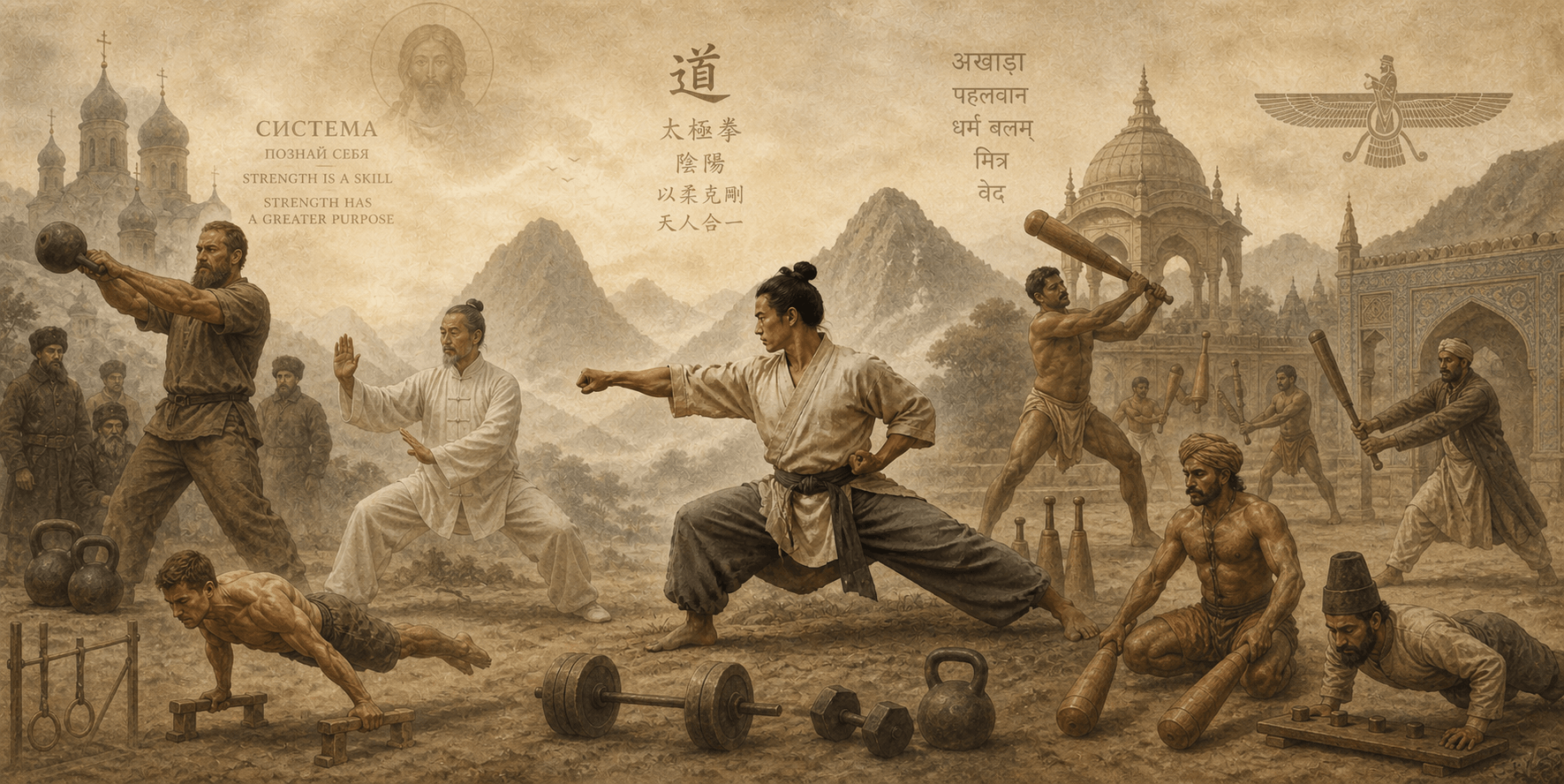
The core movement patterns, exercises and martial arts that I currently practice are sourced from Russia, China, India, Persia, and Western cultures. In the past – particularly from the martial arts perspective – I have studied systems from many other cultures, including Japan, Korea, Okinawa, the Philippines, Indonesia, Malaysia, and Thailand. But this sharing is focused on my current training regimen, so I will bound the conversation to the previously listed cultures.
From Russia, I practice Systema (CИCTEMA), the traditional Russian martial art. I also train extensively with kettlebells (girya), utilizing the “hardstyle” method. While training or reflecting on Systema – I envision the ancient monasteries where dwell the art’s roots, and the Cossack, Slavic and Rus warriors who practiced and perfected the art. I also honor the Orthodox Christian mystic practices that are integral to Systema. One of the Systema mottos is “Know Thyself”, which provides many layers of meaning and exploration to the practitioner. Contemporarily, I acknowledge the special operations units that have (paradoxically seeming) curated Systema into the 21st century. When I am working with kettlebells, I think of old-world strongmen and great feats of strength, grueling Spetsnaz training, and a commitment to perfection in, and through, strength. And there are two phrases that have stuck a chord within me and perpetuate to this day: “Strength is a Skill” and “Strength has a Greater Purpose”. This latter phrase resonates deeply within me. While examining these two Russian-sourced systems and their corresponding core philosophies side-by-side – I am struck by the polar-opposite, yet completely complementary (to me), methods prescribed for relaxation and tension. Very yin-yang, in fact. Which brings me to…
From China, I practice Yang and Chen styles of Tai Chi Chuan. I have practiced other Chinese martial arts in the past, but I am currently focused on Tai Chi. (In fact, it was my Seven Star Praying Mantis sifu who strongly encouraged me to begin practice in Tai Chi.) As I practice the Yang form, the body-mind-spirit triumvirate becomes manifest as an extension of “chi”. When I perform the Chen Cannon Fist routine, I strive to express the duality of yin and yang and to grasp the golden thread woven into all the Taoist martial arts. Whether I am doing Yang or Chen styles, I am forever aware of the latent power within the movements, the cultivation of relaxed flowing strength, and drawing from and merging with the natural energies surrounding me. Perhaps most importantly – I feel a deep bond to the ancient Chinese traditions and arts, and Tai Chi Chuan enables this connection to endure and thrive.
From India, I train with Indian clubs, jori, karlakattai and gada. Additionally, I train with Persian meel and shena (note: jori, karlakattai and meel are large wooden clubs; gada is a mace – all of which are swung; shena is a push-up board). I love these tools. From a purely physical perspective, the improvement in my shoulders and thoracic spine has been awesome. Exploring the legacy of the clubs, jori, karlakattai and gada, you discover a rich history of warriors, wrestling, spiritual devotion, and ritual. Persian meel are very similar to Indian jori (I don’t know which is the forerunner of the other; there are conflicting theories on this topic; in fact some references call out Egypt as the oldest source), and a profound warrior legacy also surrounds this practice, accentuated by a philosophy of nobility and a deep spirituality. In India, the schools or training halls are known as Akhara, and the practitioners are Pahlawans (or Pahlewans); In Persia, they are known as Zurkhaneh and Pahlavani, respectively. I feel a deep connection to ancient Persian and Indian cultures, including the Zoroastrian faith, Mitra, the Vedas and Sutras, and many other historical and spiritual touchstones.
From Western cultures I train in various calisthenics (from the Greek “kallos” – which is beauty; and “sthenos” – which is strength; therefore, calisthenics = beautiful strength) and weights/resistance training. Most of my training in this area is calisthenics, or bodyweight strength exercises. Calisthenics covers an extremely diverse set of focus areas, including flexibility, gymnastics, pure strength, dynamic power movements, enhanced mobility, – or, ideally – all the above. My personal path has focused upon strength, mobility, and flexibility. My weights/resistance training, beyond the kettlebells, includes only the core compound movements (squat, deadlift, press) for the purpose of maintaining absolute strength and adequate muscle mass. Applying a Socratic method to movement and kinesiology I also attribute to the methodical western approach, but I acknowledge the West cannot claim exclusive rights here. However, I can confidently say that western methods and principles have produced a great deal of the “How” and “Why” exercises should be performed, as well as the evolution of programming that enables optimal progress in performance and recovery.
It may seem that I am applying a “jack of all trades” approach to these various training modalities; I like to say I am a “journeyman of many arts” 😉. Whether this is true or not, I feel enriched from the exposure to, and practice of, these styles of movement and exercise – and the cultures that spawned them – which engenders a more profound connection to the people, traditions, history, legends and myths of these legacies. And for me, this is the point: to embrace, study and immerse myself within the parent cultures of these movement systems. Then my practice elevates beyond physical movements alone, and that is where I find the deeper rewards.
This is how I imbibe the spirit of Physical Culture – by devoting study to both the “physical” and the “culture”. This approach is highly congruent with, or perhaps even an extension of, Bruce Lee’s core philosophy of Jeet Kune Do: “Absorb what is useful”. This absorption has enhanced my life, and, for this, I am deeply grateful. I will continue along this Path…
I need to give special acknowledgement to Guro Dan Inosanto for instilling this perspective upon my practice, as he was the first martial arts teacher that emphasized the extreme importance of learning and sharing from the cultures of the martial arts you are studying. And to also acknowledge and give credit to those parent cultures as the original source of a movement, skill, drill, or technique. I could listen to Guro speak on these subjects for hours… he is literally a walking encyclopedia of martial arts knowledge, an incredible teacher and amazing human being.
Lastly – and this realization did not surface until I had written, re-written, edited and re-edited this little article multiple times – I noticed that the cultures I am speaking of here – i.e. Russia, India, Persia (Iran) and China – 3 out of 4 are currently considered an adversary (politically) of the US. This reality paints a complex background around this discussion of culture and emphasizes the need for a more collective awareness; an awareness that separates historical traditions and values of a people, and the goodness offered by them, from political regimes. It is the cultures, and their traditions where the truth, heart and soul of a people reside; not in its politics. There is so much to learn and absorb from these cultures… I pray that we can discover and honor those cultural facets worthy of the human spirit – the elements that bring us closer together as human beings. The elements that allow us to realize how much we have in common – vs. highlighting those things that tear us down and pull us apart. I find it a source of inspiration and hope that the cultural values I refer to in this article often provide the pathways to that common ground. May it continue to be so…